





Office Supplies
D-Ring vs. O-Ring Binder: Which Ring Style is Best for Your Needs?
That standard round ring binder you’ve used since grade school might actually be the biggest threat to your most valuable documents. While it seems like a simple office staple, the geometry of your binder’s hardware determines whether your pages stay pristine or end up with jagged, torn holes. Choosing between a d ring vs o ring binder isn’t just a matter of preference; it’s a critical decision about the long-term archival health and organization of your information.
It’s frustrating when a full binder refuses to lay flat or when pages get caught in that tiny gap between the rings. We know you want your storage to be efficient and your contents to remain secure from dust and mechanical wear. This guide will help you discover how to maximize storage capacity and ensure total document preservation. We’ll explain why D-rings offer up to 25% more sheet capacity than round rings and how specific ring styles prevent the stress that leads to permanent indentations on cards or papers. You’ll gain the technical knowledge needed to select a binder that provides the industrial-grade durability and professional organization your project demands.
Key Takeaways
- Master the mechanics of vertical stacking to maximize your storage space and keep your documents perfectly aligned.
- Navigate the d ring vs o ring binder choice by learning which mechanism prevents common “Ring Ding” damage that ruins first-page aesthetics.
- Match your organizational goal to the right hardware, from high-capacity archival storage to slim, professional presentation tools.
- Protect your documents from chemical damage by understanding the vital difference between high-quality polypropylene and standard off-gassing vinyl.
- See why an enclosed case design offers superior defense against dust and debris compared to traditional open-sided binders.
The Geometry of Organization: Defining D-Ring vs. O-Ring Binders
The efficiency of your filing system starts with a simple geometric profile. While most people grab the first binder they see on a shelf, professional organizers and archivists look closer at the metal hardware inside. The choice between a d ring vs o ring binder dictates how your pages move, how many sheets you can store, and how well those documents are protected from mechanical stress. Understanding these shapes is the first step toward a more reliable organizational system.
What is an O-Ring (Round Ring) Binder?
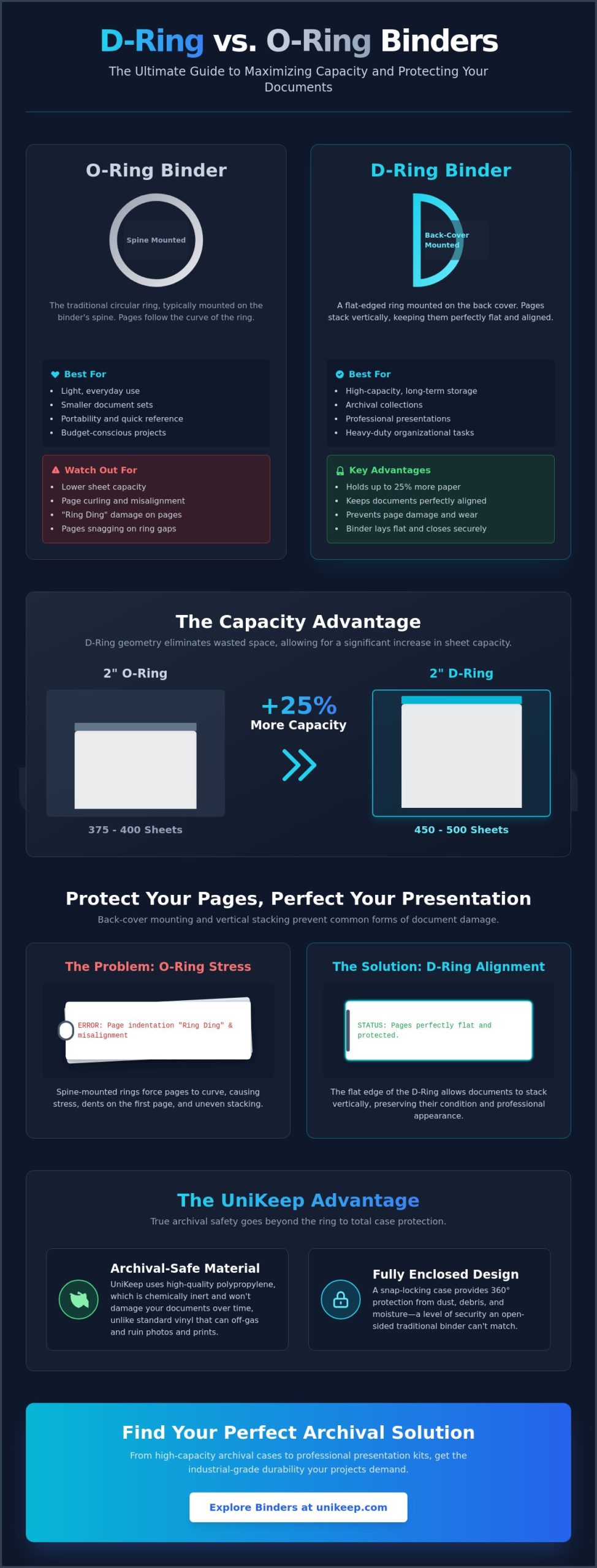
The O-ring is the traditional circular mechanism found in most standard school and office supplies. It’s the original design for the Ring binder, featuring a perfectly round loop that opens and closes at the center. In this configuration, the rings are typically mounted directly to the spine of the binder. This setup is excellent for light use, quick reference, or budget-conscious projects where portability is the main goal. However, because the rings are curved on both sides, pages naturally follow that curve. This often leads to curling or “page creep” if the binder is even slightly overstuffed.
What is a D-Ring Binder?
A D-ring binder features a specialized mechanism with one straight vertical edge and one curved side, forming the letter “D.” Unlike round rings, these are almost always mounted to the back cover rather than the spine. This engineering choice allows the straight edge of the ring to remain stationary while the curved part moves to open or close. It’s a design built for high-capacity storage, archival collections, and professional presentations. Professional environments favor this style because it keeps document edges perfectly aligned, preventing the “stair-stepping” effect seen in round ring binders.
The mechanical difference goes even deeper when you look at straight versus angled D-rings. A straight D-ring holds pages in a neat vertical stack against the back cover. An angled D-ring, often called a slant ring, is slightly tilted to allow for even smoother page turning and an even higher sheet capacity. This subtle change in geometry can increase storage by up to 25% compared to a standard round ring of the same size. When the binder is closed, the pages in a D-ring sit flat against the back cover. In contrast, pages in an O-ring must curve around the spine. This difference is why D-ring binders stay closed more reliably and protect your contents from dust more effectively.
- O-Ring: Best for slim profiles and frequent, quick page flipping in smaller document sets.
- D-Ring: Best for long-term storage, high-volume filing, and heavy-duty organizational tasks.
Choosing the right ring shape isn’t just about aesthetics. It’s about matching the tool to the volume of your work. If you’ve ever struggled to close a binder that felt like it was bursting at the seams, you’ve experienced the limitations of a round ring. Upgrading to a D-ring solves that problem by changing the way the paper interacts with the hardware, providing a more stable and professional finish to any collection.
Capacity and Mechanics: Why the Ring Shape Matters for Your Documents
Storage capacity isn’t just a number on a label; it’s a result of mechanical engineering. When you compare a d ring vs o ring binder, the most immediate difference is how much paper you can actually fit inside before the rings stop closing properly. This volume difference stems from the fundamental geometry of the ring itself. Rectangular paper doesn’t naturally fit into a circular space without wasting the corners of that circle. By using a D-shape, you’re providing a flat wall for the paper to stack against, which eliminates the dead space found in round rings.
The 25% Capacity Rule
The volume difference between a circle and a D-shape is significant. In a round ring, the paper must follow the curve of the metal. As the stack grows, the pages toward the top and bottom of the stack are pushed further toward the center of the binder. This creates a “bulging” effect that forces the binder covers apart even when the rings aren’t full. A 2-inch D-ring typically holds 450-500 sheets compared to 375-400 in a round ring. This 25% increase in efficiency means you can use a smaller binder for the same amount of content, saving valuable shelf space in your office or archive room.
Spine vs. Back-Cover Mounting
The location of the ring mechanism is just as important as its shape. Most O-ring binders feature spine-mounted hardware. This design is common because it’s cheaper to manufacture, but it forces your documents to move every time you open or close the front cover. This constant shifting puts unnecessary stress on the punched holes of your papers. If you’re looking for professional-grade stability, you’ll find it in back-cover mounting. By attaching the rings to the back panel, the entire document stack remains stationary while the cover moves independently. This mechanical setup significantly increases the longevity of the binder’s hinges and prevents the “page curling” that ruins important presentations.
Understanding these dimensions helps you clear up the common confusion between spine width and ring size. A binder with a 1-inch ring might have a 1.5-inch spine to accommodate the cover thickness and the ring’s footprint. When the rings are mounted to the back cover, the binder sits more squarely on a shelf, preventing it from leaning or warping over time. If you need a solution that maximizes every square inch of your storage, you should explore the range of 3 ring binders designed with these precise mechanical advantages in mind.
Efficiency in organization is about reducing friction. Every time a page gets stuck or a binder fails to stay closed, your workflow is interrupted. Choosing the D-ring profile ensures that your vertical column of paper stays neat, aligned, and easy to flip through. It’s a small mechanical shift that delivers a massive improvement in daily utility.
Protection vs. Portability: Addressing the ‘Ring Gap’ and Document Damage
Choosing between a d ring vs o ring binder isn’t just about how much you can store; it’s about how long your documents will last. While round rings are portable and familiar, they introduce specific physical risks to your papers that many users don’t consider until the damage is already done. If you’ve ever noticed mysterious crescent-shaped indentations on your reports or trading cards, you’ve encountered the “Ring Ding.” This occurs because the circular arc of an O-ring naturally presses against the stack when the binder is closed, creating high-pressure contact points that leave permanent marks.
Eliminating Page Curl and Indentations
The straight-edge geometry of a D-ring removes this pressure entirely. By providing a flat vertical wall, the hardware allows your documents to rest in a neutral position without being forced into a curve. Archival stress is the constant mechanical tension placed on paper or plastic protectors by the forced circular path of a standard ring. Because the paper stays flat, collectors of high-value items like photos, stamps, or top loader binders almost exclusively rely on D-ring mechanisms. It’s the only way to ensure that the first and last pages of a collection don’t end up with “page curl,” a condition where the paper permanently takes on the shape of the ring.
Durability of the Mechanism
The “Ring Gap” is another common failure point in standard office binders. Over time, the tension in O-ring triggers can weaken, causing the two halves of the ring to misalign. Even a microscopic gap is enough to snag a page, leading to torn holes and frustrated users. Heavy-duty D-ring locks are typically engineered with higher gauge steel and more robust spring tension to keep the connection seamless. This precision is vital for binders that see frequent daily reference, as it facilitates smooth page turning without the constant fear of a snag.
At UniKeep, we take this protection a step further by integrating these mechanisms into a fully enclosed case design. While the ring style handles the internal document health, the outer shell protects the hardware itself from impact. Standard binders often fail because the rings get bent when the binder is dropped or crammed into a backpack. An enclosed case ensures the rings stay perfectly aligned, preserving the smooth transition of your pages for years. If you notice your rings aren’t snapping shut with a crisp, audible click, it’s a sign the mechanism is failing. Replacing it before a snag occurs is the best way to prevent document loss.
Whether you’re archiving historical records or managing a high-traffic office manual, the ring profile dictates the lifespan of your work. By moving away from the circular path of the O-ring, you eliminate the primary sources of mechanical wear. It’s a simple upgrade that pays dividends in document preservation and daily ease of use.
Choosing the Right Binder for Your Specific Use Case
Not all organizational challenges are created equal. The debate of d ring vs o ring binder often settles itself once you look at the stakes of your project. A student’s class notes have different requirements than a company’s safety data sheets or a collector’s rare stamps. Matching the hardware to the environment ensures that your organizational tool doesn’t become a liability over time.
Collectors: Trading Cards, Stamps, and Photos
For collectors, preservation is the primary goal. D-rings are the non-negotiable choice here because they facilitate perfectly flat stacking. This is especially vital for those using top loader binders, where the added thickness of the plastic sleeves requires a vertical alignment that round rings simply can’t provide. When you store high-value assets, you need archival quality binders that prevent chemical transfer and mechanical damage. The D-ring’s straight edge keeps the weight of the collection distributed evenly, protecting your cards or photos from the permanent “ring marks” that occur in standard school binders.
Corporate and Industrial Applications
In a professional setting, the choice often comes down to volume versus portability. If you’re creating a slim “leave-behind” for a client presentation, an O-ring binder offers a sleek, lightweight profile that’s easy to carry. However, for internal operations, the D-ring takes the lead. Managing thick warehouse manuals or safety protocols requires the massive capacity of a 3-inch D-ring, which can hold hundreds of pages without the covers bulging or the rings snapping open.
In high-stakes environments like healthcare, organization is a matter of compliance. Medical records must be kept secure and accessible, often requiring enclosed binder systems that protect against environmental contaminants while meeting HIPAA standards. The ring style also impacts your brand’s image. If you’re investing in custom printed binders for your team, a D-ring mechanism provides a more substantial, high-end feel that reflects the quality of your business. It ensures the binder stays closed and stands straight on a shelf, projecting an image of order and efficiency.
Education and training sectors also benefit from the mechanical strength of the D-ring. Binders used by students or field employees face daily wear and tear that quickly ruins cheaper, spine-mounted round rings. By choosing a back-cover mounted D-ring, you’re investing in a tool that survives constant opening, closing, and transport. If you’re ready to upgrade your professional organization, check out our full range of industrial products to find the right fit for your facility.
Ultimately, the right binder is the one that removes friction from your daily tasks. Whether you’re archiving historical records or managing a busy office, understanding the d ring vs o ring binder distinction allows you to choose a solution that protects your work and your time.
The UniKeep Advantage: Beyond the Ring to Total Case Protection
While the d ring vs o ring binder debate focuses on the metal hardware, the material and design of the binder shell are equally vital for long-term reliability. A high-quality ring mechanism won’t save your documents if the cover itself fails or releases harmful chemicals. Professional organization requires a holistic approach that considers the environment where your binders live, whether that’s a climate-controlled office or a high-traffic industrial floor. By moving beyond traditional open-sided designs, you can achieve a level of document security that standard office supplies simply can’t match.
Why Material Matters: The Polypropylene Benefit
Standard binders are often made of vinyl, a material that presents hidden dangers to your archives. Vinyl is notorious for “off-gassing,” a process where chemicals leach out and cause ink to lift off your pages or stick to the binder covers. Over time, vinyl also becomes brittle and cracks at the hinges, especially in cold environments. UniKeep utilizes 100% recyclable polypropylene. This archival-safe material is chemically inert, meaning it won’t react with your documents, photos, or specialized binder accessories. Our commitment to industrial-strength durability ensures that every binder we manufacture resists temperature extremes and heavy use without degrading or damaging its contents.
The Enclosed Case Advantage
Most binders are open-sided, leaving your documents exposed to dust, dirt, and light. UniKeep’s fully enclosed case design provides a 360-degree seal that protects your work from every angle. This “snap-shut” case acts like a protective box, making it the superior choice for transport and long-term storage. Whether you’re moving safety manuals between workstations or storing archival collections in a warehouse, the case keeps the rings perfectly aligned and the contents pristine. This design also offers unique stackability. Because these binders act like uniform boxes, they stand perfectly straight on a shelf. This prevents the “ring lean” common in traditional binders, where the weight of the contents causes the spine to warp or the binder to tip over.
Every UniKeep product is made in the USA, ensuring consistent ring alignment and manufacturing quality that meets rigorous standards. We take pride in our heritage of craftsmanship and innovation, focusing on the daily challenges faced by our users. For ultimate peace of mind, choose a UniKeep D-ring case binder. It combines the 25% capacity boost of the D-ring with the total environmental protection of an enclosed case. It’s the most reliable way to ensure your documents stay as organized and clean as the day you filed them. If you’re ready to see the difference for yourself, explore our full selection of 3 ring binders and experience the case binder revolution.
Upgrade Your Organizational Standards Today
Choosing between a d ring vs o ring binder isn’t just a minor office decision; it’s a commitment to the longevity of your work. You now understand how the vertical stacking of a D-ring increases storage capacity while eliminating the mechanical stress that leads to torn pages and unsightly ring marks. By prioritizing back-cover mounting and archival-safe materials, you ensure your documents remain as pristine as the day they were filed.
UniKeep takes these benefits to the next level with our patented stackable case design. Every binder is Proudly Made in the USA using 100% Recyclable Polypropylene, providing an industrial-strength shield against dust and environmental wear. Don’t settle for standard binders that crack, off-gas, or fail under pressure. It’s time to invest in a solution that works as hard as you do. Shop UniKeep’s Full Range of Archival-Safe D-Ring Binders today and experience the ultimate in professional protection. Your most important collections deserve the reliability of a case binder engineered for excellence.
Frequently Asked Questions
Which binder ring style holds the most paper?
D-ring binders hold the most paper due to their unique geometric profile. Because the flat side of the “D” allows pages to stack vertically against the back cover, a 2-inch D-ring typically accommodates 450 to 500 sheets. In contrast, a round ring of the same size only holds about 375 to 400 sheets because the circular path wastes space and forces pages to curve.
Are D-ring binders better for trading card collections?
D-ring binders are superior for trading card collections because they prevent mechanical damage to the cards. When you evaluate a d ring vs o ring binder for collectibles, the straight edge ensures that card pages lay perfectly flat. This eliminates the “ring ding” phenomenon where the circular arc of a round ring presses into the first few pages of a collection, causing permanent indentations.
Why do my pages keep getting stuck in the binder rings?
Pages usually get stuck because of a misalignment in the ring mechanism known as the “ring gap.” Over time, standard round rings can lose their tension, creating a tiny space where the two halves meet. This gap snags the punched holes of your paper as you flip pages. Opting for a d ring vs o ring binder with back-cover mounting reduces this friction and keeps the mechanism aligned.
What is the difference between a straight D-ring and an angled D-ring?
A straight D-ring features a perfectly vertical edge, while an angled D-ring (or slant ring) is slightly tilted. The angled design allows for even smoother page turning and can increase sheet capacity by a small margin over the straight version. Both styles offer the primary benefit of flat stacking, which keeps your document stack neat and prevents pages from curling toward the spine.
Do D-ring binders take up more space on a shelf?
D-ring binders are more space-efficient on a shelf because they allow the covers to sit flat and parallel. In a round ring binder, the pages often bulge in the center, forcing the covers to flare out and take up extra horizontal room. Since D-rings hold more paper in a slimmer profile, you can often use a smaller spine size to store the same volume of documents.
Are round ring binders cheaper than D-ring binders?
Round ring binders are typically less expensive because the circular hardware is simpler and cheaper to manufacture. These are often produced for high-volume, low-cost markets like basic school supplies. The lower initial price often leads to higher long-term costs if you have to replace binders frequently due to ring failure or if your documents become damaged by the circular mechanism’s inherent design flaws.
How do I measure the size of a D-ring binder?
You measure the size of a D-ring binder by the length of the straight vertical part of the ring, not the width of the spine. For example, a 1-inch D-ring binder has a straight edge that is exactly one inch long. It’s a common mistake to measure the outer spine, but that dimension includes the thickness of the covers and the mounting hardware, which doesn’t reflect actual sheet capacity.
Can I customize the spine of a D-ring binder?
You can easily customize the spine of a D-ring binder to improve organization and branding. Many professional-grade binders feature a clear overlay that allows you to slide in custom-printed inserts. UniKeep’s enclosed case binders are particularly effective for this, as the full-wrap overlay covers the spine and both the front and back covers, providing a seamless, professional look for your project or presentation.
